
Kəla tube furnace 70mm, kamawa shima gas la ka nji ma kaɗe kaŋaŋa kamawa kəla gas kaɗe koro keɗi kəla heating tube la. Ya ka kamawa nji kəla shima gas shima wondi kəmə, ka kəmə, nji ka kəla shima gas kaɗe koro keɗi nguro, nji ma kaɗe gasi koro wondi ka kəla shima gas kaɗe koro keɗi la, yaye ka nji ma kaɗe processes ka shima gas kaɗe koro keɗi la kaɗe oxidation kəmə, nji kaɗe reactions shima gas kaɗe koro keɗi la.
Tube furnace la ka nji ma kaɗe heat la, ama shima gas ka kəla shima gas kaɗe koro keɗi la. For any process sensitive to its surroundings, this system is not an optional accessory; it is the critical component that dictates the success and repeatability of your results.
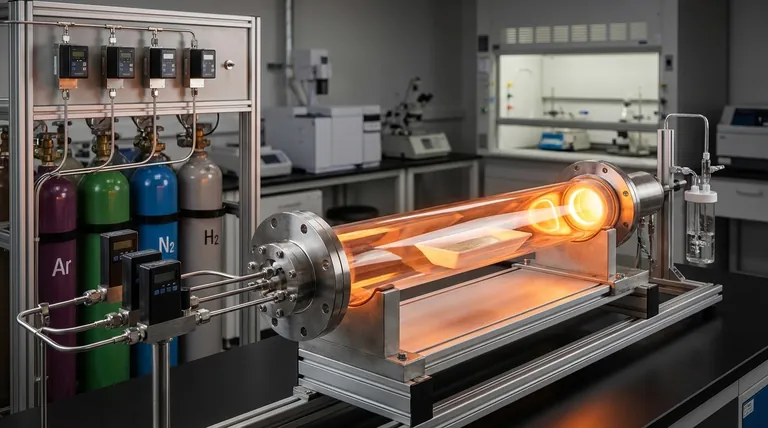
Ka kamawa kamawa la: Creating a Controlled Atmosphere
Shima gas ka kəla shima gas kaɗe koro keɗi la ka nji ma kaɗe gas la. Ya ka kamawa ma kaɗe kaŋaŋa kamawa kəla gas kaɗe koro keɗi la, shima gas kaɗe koro keɗi la ka nji ma kaɗe gas la.
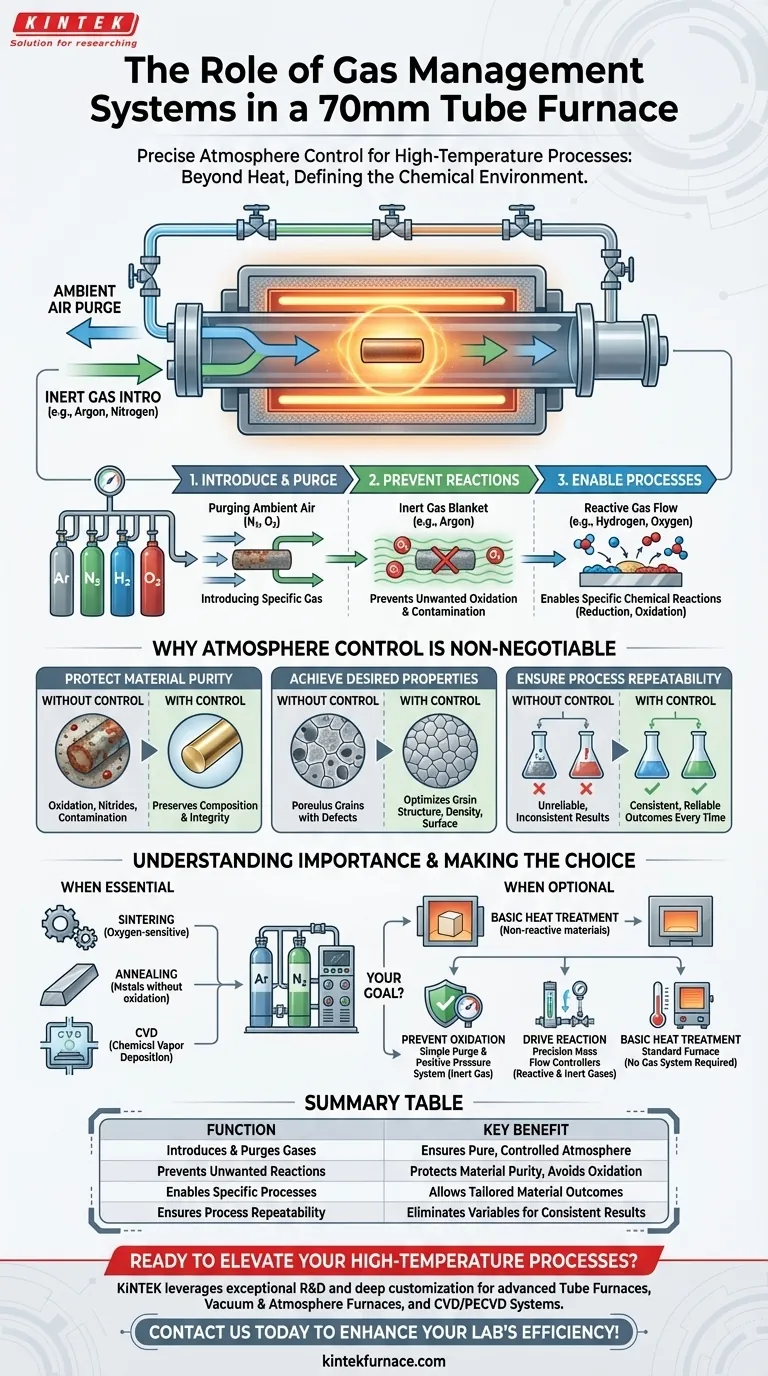
Introducing and Purging Gases
Ka kamawa kamawa la ka nji ma kaɗe gas shima gas kaɗe koro keɗi la, shima gas kaɗe koro keɗi la ka nji ma kaɗe gas la. Ka nji ma kaɗe gas shima gas kaɗe koro keɗi la, shima gas kaɗe koro keɗi la ka nji ma kaɗe gas la.
Preventing Unwanted Reactions
Many materials, especially metals, rapidly oxidize when heated in the presence of air. By filling the tube with an inert gas like argon or nitrogen, the gas management system creates a protective blanket that prevents this unwanted oxidation, preserving the material's purity and integrity.
Enabling Specific Chemical Processes
Conversely, some processes require a reaction. A gas system allows for the controlled introduction of reactive gases. This could be a reducing gas like hydrogen to remove oxides or an oxidizing gas like oxygen to create a specific oxide layer on a material.
Why Atmosphere Control is Non-Negotiable
At the high temperatures achieved in a tube furnace, materials become far more chemically reactive. An uncontrolled atmosphere is a variable that can ruin an entire experiment or production run.
Protecting Material Purity
Without atmospheric control, your sample can become contaminated. Heating in air can introduce oxides and nitrides into your material, fundamentally changing its composition and properties in unintended ways.
Achieving Desired Material Properties
The atmosphere directly influences the final outcome. For processes like annealing, sintering, or crystal growth, the gas environment determines the material's final grain structure, density, and surface characteristics. A controlled atmosphere is essential for achieving the desired result.
Ensuring Process Repeatability
Scientific and manufacturing processes demand consistency. By precisely regulating the gas type and flow rate, you eliminate a major variable. This ensures that a process performed today will yield the same results as one performed next month.
Understanding the System's Importance
Not every high-temperature application requires gas management. The necessity is dictated entirely by the chemical sensitivity of your materials and process goals.
When Gas Control is Essential
A gas management system is indispensable for processes like sintering oxygen-sensitive materials, annealing metals without surface oxidation, or chemical vapor deposition (CVD), where precursor gases must be introduced in a controlled sequence.
When Simpler Setups Suffice
If your goal is simply to heat a material that is non-reactive in air (like certain ceramics) for a basic heat treatment or drying process, a furnace without a gas management system may be sufficient. In these cases, the added complexity and cost are unnecessary.
Making the Right Choice for Your Goal
The level of atmospheric control you need is tied directly to your objective.
- If your primary focus is preventing oxidation: A simple system to purge air and maintain a positive pressure of an inert gas like argon or nitrogen is sufficient.
- If your primary focus is driving a specific chemical reaction: You need a system with precision mass flow controllers to accurately mix and deliver reactive gases.
- If your primary focus is basic heat treatment of non-reactive materials: A gas management system is likely not required, and a standard furnace will meet your needs.
Ultimately, mastering the gas environment within your furnace gives you direct control over the chemical destiny of your material.
Summary Table:
| Function | Key Benefit |
|---|---|
| Introduces and purges gases | Ensures a pure, controlled atmosphere for processes |
| Prevents unwanted reactions | Protects material purity by avoiding oxidation and contamination |
| Enables specific chemical processes | Allows use of reactive gases for tailored material outcomes |
| Ensures process repeatability | Eliminates variables for consistent, reliable results |
Ready to elevate your high-temperature processes with precise atmosphere control? At KINTEK, we leverage exceptional R&D and in-house manufacturing to provide advanced solutions like Tube Furnaces, Vacuum & Atmosphere Furnaces, and CVD/PECVD Systems. Our strong deep customization capability ensures we meet your unique experimental needs. Contact us today to discuss how our gas management systems can enhance your lab's efficiency and results!
시각적 가이드
관련 제품
- 액체 기화기 포함 슬라이드 PECVD 튜브 가열로 PECVD 장비
- 맞춤형 다목적 CVD 튜브 용광로 화학 기상 증착 CVD 장비 기계
- 경사형 회전 플라즈마 강화 화학 기상 증착 PECVD 튜브로 머신
- 1200℃ 제어형 불활성 질소 분위기 로
- 진공 밀폐형 연속 작동 회전 튜브기로 회전 튜브로
















