지식 What role does a dual porcelain boat layout play within a tube furnace? Enhance Ni-N-C Selenization with Spatial Control
작성자 아바타

기술팀 · Kintek Furnace

업데이트됨 5 hours ago

What role does a dual porcelain boat layout play within a tube furnace? Enhance Ni-N-C Selenization with Spatial Control


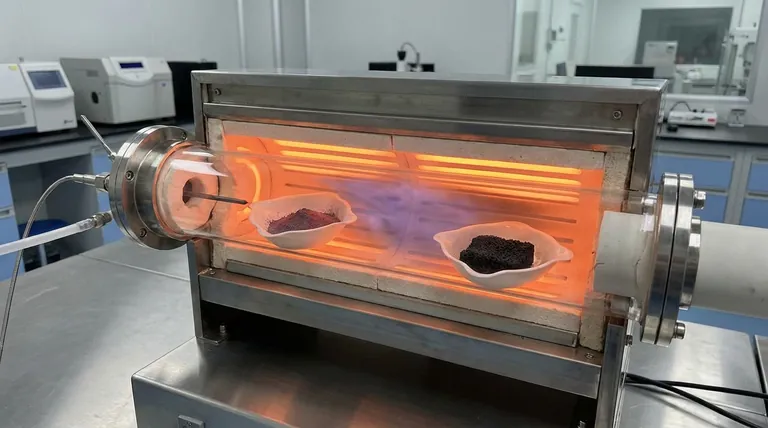
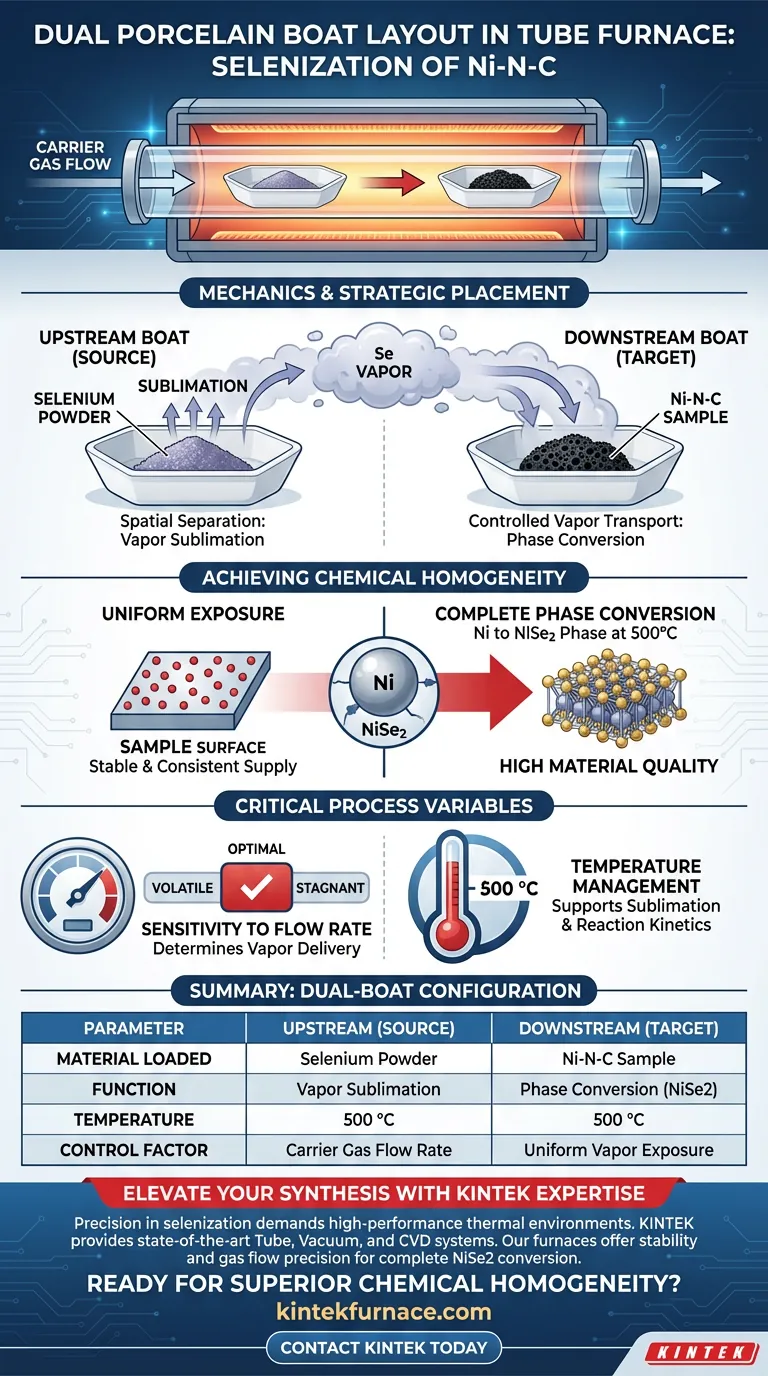
The dual porcelain boat layout serves as a spatial control mechanism for vapor deposition within the tube furnace. By placing selenium powder upstream and the Ni-N-C sample downstream, this configuration utilizes the carrier gas to transport sublimated selenium vapor uniformly across the target surface, preventing uneven reaction kinetics.

The physical separation of the source and the target is the key to stability. This arrangement ensures a consistent, continuous supply of selenium vapor, which is critical for achieving the complete conversion of nickel nanoparticles into the NiSe2 phase.

What role does a dual porcelain boat layout play within a tube furnace? Enhance Ni-N-C Selenization with Spatial Control

The Mechanics of the Dual-Boat Configuration

Strategic Component Placement

The fundamental principle of this layout is spatial separation. You place the selenium powder in the first porcelain boat, located upstream relative to the gas flow.

The Ni-N-C sample is placed in the second boat, located downstream. This ensures the sample interacts only with the vaporized selenium, rather than solid contact.

Controlled Vapor Transport

Once the furnace reaches temperature, the selenium sublimates into a vapor. The carrier gas acts as the transport vehicle, moving this vapor from the upstream boat toward the downstream sample.

Precise control of the gas flow rate is essential here. It dictates how quickly and densely the selenium vapor is delivered to the Ni-N-C surface.

Achieving Chemical Homogeneity

Ensuring Uniform Exposure

A single-boat setup or improper spacing can lead to uneven deposition. The dual-boat layout, however, facilitates a stable and consistent supply of reactant.

By relying on gas transport, the selenium is distributed evenly across the entire surface area of the downstream sample.

Complete Phase Conversion

The ultimate goal of this consistency is chemical transformation. At a processing temperature of 500 °C, the uniform supply of selenium drives the reaction to completion.

This specific environment allows the nickel nanoparticles within the Ni-N-C matrix to fully convert into the NiSe2 phase, ensuring high material quality.

Critical Process Variables

Sensitivity to Flow Rate

While the layout provides the structure, the carrier gas flow rate is the variable that determines success.

If the flow is too volatile, the selenium vapor may pass the sample too quickly to react. If the flow is too stagnant, the vapor transport becomes inconsistent.

Temperature Management

The process relies on maintaining the specific processing temperature of 500 °C.

You must ensure that the thermal profile of the furnace supports both the sublimation of the upstream selenium and the reaction kinetics at the downstream sample.

Making the Right Choice for Your Goal

To maximize the effectiveness of the dual porcelain boat layout, consider your specific objectives:

  • If your primary focus is Phase Purity: Ensure the temperature is strictly maintained at 500 °C to guarantee the complete conversion of Ni to NiSe2.
  • If your primary focus is Surface Uniformity: Prioritize the precision of your carrier gas flow rate to ensure the selenium vapor is distributed evenly across the downstream boat.

The dual-boat configuration effectively decouples the reactant source from the reaction site, giving you the control necessary to engineer precise nanomaterials.

Summary Table:

Parameter Upstream Boat (Source) Downstream Boat (Target)
Material Loaded Selenium Powder Ni-N-C Sample
Function Vapor Sublimation Phase Conversion (NiSe2)
Temperature 500 °C (Sublimation) 500 °C (Reaction)
Control Factor Carrier Gas Flow Rate Uniform Vapor Exposure

Elevate Your Material Synthesis with KINTEK Expertise

Precision in selenization requires more than just a layout; it demands a high-performance thermal environment. KINTEK provides state-of-the-art Tube, Vacuum, and CVD systems designed for the rigorous demands of nanomaterial engineering.

Our furnaces are backed by expert R&D and manufacturing, offering the stability and gas flow precision necessary for complete NiSe2 phase conversion. Whether you need a standard setup or a customizable system for your unique research needs, we deliver the reliability your lab deserves.

Ready to achieve superior chemical homogeneity? Contact KINTEK today to discuss your high-temp furnace requirements!

시각적 가이드

What role does a dual porcelain boat layout play within a tube furnace? Enhance Ni-N-C Selenization with Spatial Control 시각적 가이드

참고문헌

  1. Qiaoting Cheng, Hua Wang. Modification of NiSe2 Nanoparticles by ZIF-8-Derived NC for Boosting H2O2 Production from Electrochemical Oxygen Reduction in Acidic Media. DOI: 10.3390/catal14060364

이 문서는 다음의 기술 정보도 기반으로 합니다 Kintek Furnace 지식 베이스 .

관련 제품

사람들이 자주 묻는 질문

관련 제품

석영 또는 알루미나 튜브가 있는 1700℃ 고온 실험실 튜브 용광로

석영 또는 알루미나 튜브가 있는 1700℃ 고온 실험실 튜브 용광로

알루미나 튜브가 있는 킨텍의 튜브 퍼니스: 재료 합성, CVD 및 소결을 위해 최대 1700°C까지 정밀 가열합니다. 컴팩트하고 사용자 정의가 가능하며 진공 상태에서도 사용할 수 있습니다. 지금 살펴보세요!

실험실용 1400℃ 머플 오븐로

실험실용 1400℃ 머플 오븐로

KT-14M 머플 퍼니스: SiC 소자, PID 제어, 에너지 효율적인 설계로 1400°C의 정밀 가열이 가능합니다. 실험실에 이상적입니다.

1200℃ 제어 불활성 질소 대기 용광로

1200℃ 제어 불활성 질소 대기 용광로

킨텍 1200℃ 제어 대기 용광로: 실험실용 가스 제어를 통한 정밀 가열. 소결, 어닐링 및 재료 연구에 이상적입니다. 맞춤형 크기 제공.

고압 실험실 진공관로 석영 관로

고압 실험실 진공관로 석영 관로

킨텍 고압 튜브 퍼니스: 15Mpa 압력 제어로 최대 1100°C까지 정밀 가열. 소결, 결정 성장 및 실험실 연구에 이상적입니다. 맞춤형 솔루션 제공.

1200℃ 분할 튜브 용광로 실험실 석영 튜브가있는 석영 튜브 용광로

1200℃ 분할 튜브 용광로 실험실 석영 튜브가있는 석영 튜브 용광로

정밀한 고온 실험실 응용 분야를 위한 석영 튜브가 있는 킨텍의 1200℃ 분할 튜브 용광로를 만나보세요. 맞춤형, 내구성, 효율성이 뛰어납니다. 지금 구입하세요!

석영 및 알루미나 튜브가 있는 1400℃ 고온 실험실 튜브 용광로

석영 및 알루미나 튜브가 있는 1400℃ 고온 실험실 튜브 용광로

알루미나 튜브가 있는 킨텍의 튜브 용광로: 실험실을 위한 최대 2000°C의 정밀 고온 처리. 재료 합성, CVD 및 소결에 이상적입니다. 맞춤형 옵션을 사용할 수 있습니다.

1700℃ 제어 불활성 질소 대기 용광로

1700℃ 제어 불활성 질소 대기 용광로

KT-17A 제어 대기 용광로: 진공 및 가스 제어를 통한 1700°C의 정밀한 가열. 소결, 연구 및 재료 가공에 이상적입니다. 지금 살펴보세요!

진공 소결용 압력이 있는 진공 열처리 소결로

진공 소결용 압력이 있는 진공 열처리 소결로

킨텍의 진공 압력 소결로는 세라믹, 금속 및 복합 재료에 2100℃의 정밀도를 제공합니다. 맞춤형, 고성능, 오염 방지 기능을 제공합니다. 지금 견적을 받아보세요!

수직 실험실 석영관 용광로 관형 용광로

수직 실험실 석영관 용광로 관형 용광로

정밀 킨텍 수직 튜브 용광로: 1800℃ 가열, PID 제어, 실험실 맞춤형. CVD, 결정 성장 및 재료 테스트에 이상적입니다.

메쉬 벨트 제어 분위기 용광로 불활성 질소 분위기 용광로

메쉬 벨트 제어 분위기 용광로 불활성 질소 분위기 용광로

킨텍 메쉬 벨트 퍼니스: 소결, 경화 및 열처리를 위한 고성능 제어식 대기 퍼니스입니다. 맞춤형, 에너지 효율적, 정밀한 온도 제어가 가능합니다. 지금 견적을 받아보세요!

1400℃ 제어 불활성 질소 대기 용광로

1400℃ 제어 불활성 질소 대기 용광로

실험실 및 산업을 위한 KT-14A 제어식 대기 용광로. 최대 온도 1400°C, 진공 밀봉, 불활성 가스 제어. 맞춤형 솔루션 제공.

진공 열처리 소결 및 브레이징로

진공 열처리 소결 및 브레이징로

킨텍 진공 브레이징로는 뛰어난 온도 제어로 정밀하고 깨끗한 접합부를 제공합니다. 다양한 금속에 맞춤화할 수 있으며 항공우주, 의료 및 열 응용 분야에 이상적입니다. 견적을 받아보세요!

실험실 석영관로 RTP 가열관로

실험실 석영관로 RTP 가열관로

킨텍의 RTP 급속 가열 튜브로는 정밀한 온도 제어, 최대 100°C/초의 급속 가열, 고급 실험실 애플리케이션을 위한 다양한 분위기 옵션을 제공합니다.

진공 스테이션 CVD 기계가 있는 스플릿 챔버 CVD 튜브 퍼니스

진공 스테이션 CVD 기계가 있는 스플릿 챔버 CVD 튜브 퍼니스

진공 스테이션이 있는 분할 챔버 CVD 튜브 용광로 - 첨단 재료 연구를 위한 고정밀 1200°C 실험실 용광로입니다. 맞춤형 솔루션 제공.

실험실용 1700℃ 고온 머플 오븐 용광로

실험실용 1700℃ 고온 머플 오븐 용광로

KT-17M 머플 퍼니스: 산업 및 연구 분야를 위한 PID 제어, 에너지 효율, 맞춤형 크기를 갖춘 고정밀 1700°C 실험실 퍼니스입니다.

소형 진공 열처리 및 텅스텐 와이어 소결로

소형 진공 열처리 및 텅스텐 와이어 소결로

실험실용 소형 진공 텅스텐 와이어 소결로. 뛰어난 진공 무결성을 갖춘 정밀한 이동식 설계. 첨단 재료 연구에 이상적입니다. 문의하세요!

600T 진공 유도 핫 프레스 진공 열처리 및 소결로

600T 진공 유도 핫 프레스 진공 열처리 및 소결로

정밀한 소결을 위한 600T 진공 유도 핫 프레스 용광로. 고급 600T 압력, 2200°C 가열, 진공/대기 제어. 연구 및 생산에 이상적입니다.

제어 불활성 질소 수소 대기 용광로

제어 불활성 질소 수소 대기 용광로

통제된 환경에서 정밀한 소결 및 어닐링을 위한 킨텍의 수소 분위기 용광로에 대해 알아보세요. 최대 1600°C, 안전 기능, 사용자 정의 가능.

치과 실험실용 진공 치과용 도자기 소결로

치과 실험실용 진공 치과용 도자기 소결로

KinTek 진공 포세린 퍼니스: 고품질 세라믹 수복물을 위한 정밀 치과 기공소 장비입니다. 고급 소성 제어 및 사용자 친화적인 작동.

화학 기상 증착 장비용 다중 가열 구역 CVD 튜브 용광로 기계

화학 기상 증착 장비용 다중 가열 구역 CVD 튜브 용광로 기계

킨텍의 멀티존 CVD 튜브 용광로는 고급 박막 증착을 위한 정밀 온도 제어 기능을 제공합니다. 연구 및 생산에 이상적이며 실험실 요구 사항에 맞게 맞춤 설정할 수 있습니다.


메시지 남기기